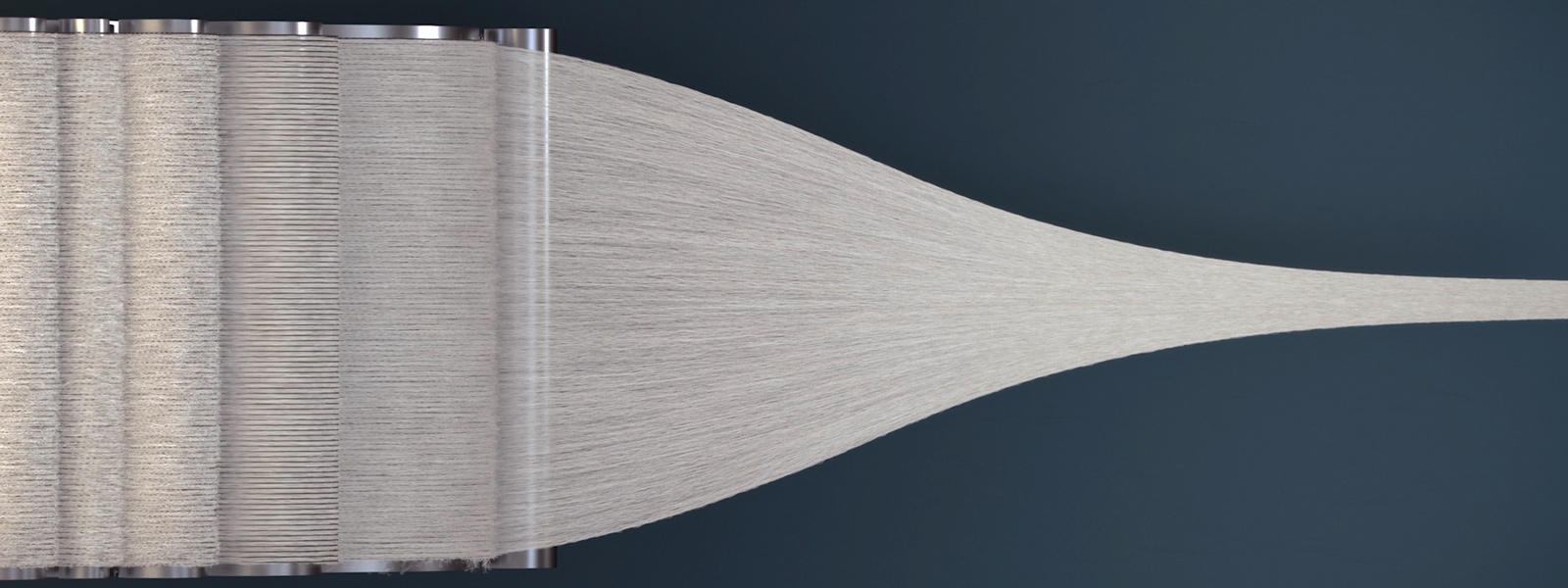
Machine washable wool brings together the natural performance of wool with the convenience of modern garment care. It retains the fibre’s recognised benefits such as breathability, thermoregulation, moisture management, odour resistance and biodegradability, while allowing safe laundering in domestic washing machines.
Achieved through advanced fibre engineering, including established Hercosett systems and emerging chlorine-free alternatives, these treatments improve shrink resistance and dimensional stability without masking wool's inherent properties. The result remains fundamentally wool: natural in feel, performance and biodegradability, but easier to care for and longer lasting in use.
No fibre is impact-free. But enabling wool garments to be washed easily and worn for longer plays a critical role in circularity outcomes. Learn more about Wool and Circularity here.
Laine résistante aux intempéries
Le tissu résistant au vent et à l'eau, composé à 100 % de laine mérinos, est utilisé dans de nombreuses catégories de produits, comme les imperméables, les chaussures, les shorts de surf et les masques.
Why wool shrinks: The fibre science
Wool is a protein fibre with a natural scale structure. When exposed to heat and moisture the scales lift and with mechanical agitation start to lock onto the scales of other fibres in a ratchet-like mechanism. This process is irreversible and leads to fibre entanglement, fabric densification or garment shrinkage.
Machine washable treatments work by either:
1. Removing or smoothing scales
2. Reducing inter-fibre friction
3. Combining both approaches
What Is Superwash?
“Superwash” is the industry term used to describe wool that has undergone shrink-resist treatment of some type to make it machine washable.
Typical performance criteria of Superwash:
- Machine washability
- Resistance to felting shrinkage
- Retention of softness
- Durability over repeated wash cycles
Superwash-treated wool is widely used in knitwear, socks, base-layers, and next-to-skin garments.
What is the Hercosett process?
Hercosett is the most widely commercialised shrinkresist system used to produce machine washable wool.
It is a two-step process:
Step 1: Chlorine pre-treatment
- Modifies fibre scales
- Creates reactive sites on the fibre surface
Step 2: Hercosett polymer application
- A polyamide epichlorohydrin resin (Hercosett) is applied
- Anchors to the fibre surface
- Forms a thin, durable layer.
This polymer does not form a traditional plastic coating. Instead, it bonds with wool’s protein structure, creating an integrated fibre-polymer matrix that preserves breathability, moisture management and odour resistance while delivering machine washability and shrink resistance. Importantly, research shows treated wool remains biodegradable and does not generate microplastics.
Outcome:
- Excellent shrink resistance
- High-wash durability
- Soft handle retention
The Hercosett system has been industrially optimised over decades and remains a benchmark for performance. it is considered Best Available Technology (BAT) within the EU and is aligned with the EU’s REACH regulation.
Environmental and safety considerations
Modern machine washable treatments operate under strict environmental and occupational controls.
Key factors include:
- Closed-loop processing systems
- Wastewater treatment
- Effluent monitoring
- Chemical handling protocols
Industry frameworks classify optimised shrink-resist systems as best available practice when managed responsibly.
Myths and Misconceptions
Myth 1: Machine washable wool is no longer natural
Machine washable wool remains a natural fibre product. Treatments modify the surface, not the fibre’s internal protein structure. A polymer is used in the treatment, and polymers are a form of plastic in chemistry terms. But it doesn’t coat wool like a plastic film. Instead, it bonds to the fibre surface and forms a microscopic matrix with wool’s natural proteins. This helps prevent shrinkage while keeping wool breathable, odour-resistant and comfortable. So, the fibre is still natural wool, just made easier to care for and longer lasting.
Myth 2: All treatments are environmentally harmful
Impacts depend on chemistry, process control, and wastewater management. Modern facilities operate under regulated discharge limits, and wool processors must comply.
Myth 3: Washable wool performs worse
Shrinkresist treatments are engineered to preserve softness, comfort, durability and biodegradability.
Myth 4: Superwash and Hercosett are the same thing
Superwash is a category. Hercosett is one specific technology within that category.
Myth 5: Machine washable wool sheds microplastics
Microplastics form when solid plastic materials fragment into tiny pieces. Machine-washable wool doesn’t have a solid plastic layer to fragment. The treatment is integrated into the fibre surface. Research confirms that the Chlorine-Hercosett anti-shrink treatment applied to wool can accelerate biodegradation in both soil and marine environments. Learn more about wool’s biodegradability here.
Myth 6: Machine washable wool is plastic in disguise
It’s understandable to think that way, but not all polymers behave the same. In this case, the polymer is bonded to a natural fibre, doesn’t shed as microplastics, and biodegrades alongside the wool at end of life. So, the environmental profile is very different from conventional plastics designed to persist in the environment.
Polymers are used in machine-wash treatments for wool much like the thin coatings applied to vitamins or supplements. In both cases, the coating or bonding agent serves a protective function: for wool, it stabilises the fibre so it can be safely washed without shrinkage or felting; for supplements, it preserves the nutrient and controls release. In neither case does the coating replace the natural core - the wool fibre remains fully natural, breathable, odour-resistant and biodegradable.